
Aditya-L1 is meant to observe the corona, which are the outer layers of the Sun, extending to thousands of kilometres.
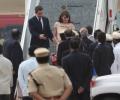
French President Nicholas Sarkozy, who kicked off his 4-day India visit in Bengaluru on Saturday, made a strong case for India's inclusion as a permanent member of the United Nations Security Council.It was unthinkable that India was not yet a permanent member of the UNSC, said Sarkozy, who is visiting India with his wife Carla Bruni.


"It (the cost of setting up the launch pad) is around Rs 600 crore. A major national facility (for training astronauts) will be established in Bengaluru, Indian Space Research Organisation Chairman G Madhavan Nair told PTI.
Billionaire and Mahindra Group chairman Anand Mahindra along with top Silicon Valley investors Naval Ravikant and Balaji Srinivasan are backing space tech start-up Agnikul as part of a new funding round. Chennai-based Agnikul said, on Thursday, that it has raised $11 million in Series A funding round led by Mayfield India. It is the largest funding round for a private Indian space technology company in the country. Existing investors pi Ventures, Speciale Invest and Artha Venture Fund also invested in this round.
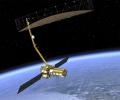
NISAR will not be used for surveillance and will be used to observe the earth.

The crater was formed during the Nectarian period, which dates back to 3.85 billion years and is one of the oldest time periods in the Moon's history, the team, including researchers from the Physical Research Laboratory and Indian Space Research Organisation (ISRO), Ahmedabad, said.
India will develop its own version of the Global Positioning System by launching seven satellites in 6 years. The Indian Regional Navigation Satellite System, to be functional by 2012, will be used for surveillance, telecommunications, transport etc.
Meeting the long pending Indian demand, the Barack Obama administration on the eve of India's Republic Day removed from its entities as many as nine India space and defence related companies, including those from the Indian Space Research Organisation and Defence Research and Development Organisation.

Heralding a new era, India on Friday night launched its heaviest commercial space mission ever with its polar rocket successfully putting five British satellites into the intended orbit after a flawless takeoff.
ISRO, through Antrix Corporation, has inked commercial agreements with EADS Astrium of Europe to jointly make and supply two commercial communication satellites.
The satellite will give India the capability to keep tabs on missile launches in its neighbourhood.
India is on the verge of entering 'big league' in the world aviation scene with the launch of satellite-based navigation system, GAGAN, next year, Civil Aviation Minister Praful Patel said on Tuesday.
"We have short listed scientific experiments from researchers in five countries the US, UK, Sweden, Bulgaria and Germany."

Training modules also cover academic courses, Gaganyaan flight systems, nicro-gravity familiarisation through parabolic flights, recovery training, mastering of flight procedures and training on crew training simulators, according to ISRO sources.
The nuclear nonproliferation lobby has urged the United States administration to ensure that America's dual-use technology is not diverted by New Delhi to its nuclear weapons programme.

The ISRO on Sunday scripted yet another history after its LVM3 rocket successfully placed 36 satellites of United Kingdom-based OneWeb group company into intended orbits.
Indian Space Research Organisation (ISRO) Chairman G Madhavan Nair today said the country should be proud of Chandrayaan-1 for being a successful low-cost planetary mission.

On Thursday, the four-stage, 44.4 metre tall PSLV-C53 that blasted off from the second launch pad of Satish Dhawan Space Centre and placed the three Singapore satellites--DS-EO, NeuSAR and SCOOB-1 in intended orbit.
Seven months after its launch, India's maiden mission to the moon Chandrayaan has reportedly developed a technical snag. Reports suggest that the star sensor on board Chandrayaan has malfunctioned, thus partially crippling the spacecraft.Due to the malfunctioning of the critical component, it has now become difficult to steer Chandrayaan. Scientists at the Indian Space Research Organisation, which had successfully launched the moon mission, have patched two sensors.

In his latest tweet, the 58-year-old actor said the successful landing of Chandrayaan-3 on the Moon's uncharted south pole was a moment of celebration for mankind.
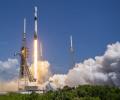
'ISRO recommended to carry out in-situ repairs or replacement and conduct a low-temperature leak test to validate system performance and integrity, before proceeding with launch.'
RISAT-2, India's spy satellite, was successfully placed into the 550 km orbit around Earth on Monday morning.Earlier, the PSLV-C12, carrying 300-kg Radar Imaging Satellite and 40-kg Micro Satellite ANUSAT, had lifted off from Indian Space Research Organisation's Satish Dhawan space Centre in Sriharikota today morning. The RISAT-2 has an all weather capability to take images of Earth.

The successful launch of seven satellites on Wednesday has placed India among the best in the field of space research. And, behind the success story of the launch is a team that has been silently working for five long years.

According to sources in the Bengaluru-headquartered space agency, under the Department of Space, delivery of hardware by the industry was hit due to the lockdown imposed in several States to contain the pandemic in recent months.
The TV broadcasting and VSAT networks, he said, have become `niche' market for satellite services in India and half of the satellite TV channels and their news feeds covering India are in the INSAT system.
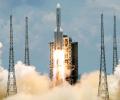
India's first privately developed rocket -- Vikram-S -- is set for launch in a sub-orbital mission with three payloads between November 12 and 16, Hyderabad-based space startup Skyroot Aerospace announced on Tuesday.

The Indian Space Research Organisation (ISRO) has rescheduled the launch of PSLV-C59 to Thursday due to an "anomaly" detected in the PROBA-3 spacecraft. The launch was originally scheduled for Wednesday at 4.08 pm from the spaceport in Sriharikota. The anomaly was identified by scientists at the European Space Agency (ESA), who requested the rescheduling of the launch. The PROBA-3 mission, a joint project between ESA and ISRO, aims to study the Sun's corona using two spacecraft that will fly in formation. The launch will provide valuable insights for ISRO's future solar missions, including the Aditya-L1 mission which was launched in September 2023.

India's Mars orbiter craft has completed eight years in its orbit, well beyond its designed mission life of six months. Plans on a follow-on 'Mangalyaan' mission to the Red Planet, however, are yet to be firmed up.

"The level of education and knowledge being imparted by many colleges... they are not up to the mark. Instead of concentrating on quantity, these institutions should concentrate on quality," he told PTI in an interview.
The final 52-hour countdown for the October 22 launch of the country's first moon mission, Chandrayaan-I, began early on Monday morning at the Satish Dhawan Space Centre at Sriharikota in Andhra Pradesh.
A memorandum of understanding to this effect was signed on Wednesday.
India plans to set up about 1,000 automatic weather stations in the next financial year as part of the Indian Space Research Organisation's expansion programme to improve meteorological services.

Here is the timeline of the moon mission as undertaken by the Indian Space Research Organisation.
The placing of four satellites into orbit on October 12, 2011 is yet another milestone in the glorious career of Indian Space Research Organisation's trusted Polar Satellite Launch Vehicle.
In the next 25 years, we are looking at a maritime force that is truly a large blue water navy and an air force that is in reality an aerospace force.
The Indian Space Research Organisation on Wednesday successfully launched seven satellites in 1,200 seconds with the help of its most trusted Polar Satellite Launch Vehicle from the Sriharikota spaceport in Andhra Pradesh coast.The launch was carried out as per schedule at 11.51 am and ended at 12.06 pm.Vice President Hamid Ansari, who was present at the Satish Dhavan Space Centre, congratulated the scientists and technocrats over this splendid achievement for the nation.

Astronaut Shubhanshu Shukla returns to Earth after an 18-day mission aboard the International Space Station, marking a significant milestone for India's space program and carrying out crucial scientific experiments.
"It will take about five-and-half days for Chandrayaan-1 to get to the moon," officials said, adding that the probe will be in a 100 km polar orbit around the Moon.

Chandrayaan-2 was launched on July 22, 2019 and inserted into the lunar orbit on August 20, exactly one year ago.
